Last reviewed on September 30, 2024
General Nuclear Medicine
- What is General Nuclear Medicine?
- What are some common uses of the procedure?
- How should I prepare?
- What does the equipment look like?
- How does the procedure work?
- How is the procedure performed?
- What will I experience during and after the procedure?
- Who interprets the results and how do I get them?
- What are the benefits vs. risks?
- What are the limitations of General Nuclear Medicine?
What is General Nuclear Medicine?
Nuclear medicine uses small amounts of radioactive material combined with a carrier molecule. This compound is called a radiotracer or radiopharmaceutical. Doctors use nuclear medicine tests to diagnose, evaluate, and treat various diseases. These include cancer, heart disease, gastrointestinal, endocrine, or neurological disorders.
Nuclear medicine determines how the body is functioning at a cellular level. It is able to:
- find disease in its earliest stages
- target treatment to specific cells
- monitor response to treatment.
Diagnosis
Nuclear medicine tests use a small amount of radioactive material combined with a carrier molecule. This compound is called a radiotracer. These tests help diagnose and assess medical conditions. They are non-invasive and usually painless.
When a radiotracer is injected into the body, it builds up in certain areas of the body. Radiotracers go to the area of the body that needs to be examined, such as a cancerous tumor or inflamed area. They can also bind to certain proteins in the body.
The most common radiotracer is F-18 fluorodeoxyglucose (FDG). It is just one of many radiotracers in use or in development. FDG is a compound similar to glucose, or sugar. Highly active cancer cells need more energy than normal cells. As a result, they absorb more glucose. An imaging device that detects energy given off by FDG creates pictures that show the location of the radiotracer in the body.
Radiotracers are usually given via injection, but they may also be swallowed or inhaled.
Therapy
Nuclear medicine therapy uses a small amount of radioactive material combined with a carrier molecule. This is called a radiopharmaceutical. Nuclear medicine therapies treat cancer and other conditions. Radiopharmaceuticals attach to specific cells and then deliver a high dose of radiation, destroying them.
What are some common uses of the procedure?
Imaging
Doctors use nuclear medicine imaging procedures to see what’s happening at a cellular level and to better understand how the body is functioning.
In adults, doctors use nuclear medicine to:
Heart
- look at blood flow and function (such as a myocardial perfusion scan)
- detect coronary artery disease and the extent of coronary stenosis
- assess damage to the heart following a heart attack
- evaluate treatment options such as bypass heart surgery and angioplasty
- evaluate the results of revascularization procedures
- check for heart transplant rejection
- check heart function before and after chemotherapy (MUGA)
Lungs
- check for breathing and blood flow problems
- assess lung function for surgery
- check for lung transplant rejection
Bones
- check bones for fractures, infection, and arthritis
- evaluate metastatic bone disease, prosthetic joints, and bone tumors
- look for biopsy sites
Brain
- investigate abnormalities in patients with seizures, memory loss and blood flow problems
- detect the early onset of neurological disorders such as Alzheimer's disease
- assist in surgical planning and radiation planning
- identify areas of the brain that may be causing seizures
- evaluate abnormalities in patients with suspected Parkinson's disease or other movement disorders
- check for a recurring brain tumor
- look for biopsy sites
Other Body Systems
- look for inflammation or abnormal function of the gallbladder
- look for bleeding into the bowel
- assess complications following gallbladder surgery
- evaluate swelling caused by the backup of lymph fluid (lymphedema)
- find the cause of unexplained fever
- find infection
- measure thyroid function
- help diagnose blood cell disorders
- evaluate how the stomach empties
- evaluate the flow of spinal fluid and look for leaks.
In adults and children, doctors also use nuclear medicine to:
Cancer
- determine the stage of cancer
- look to see if cancer has spread
- find the lymph node closest to a tumor (sentinel)
- plan treatment
- evaluate how the cancer is responding to therapy
- check for recurring cancer
- detect rare tumors of the pancreas and adrenal glands
Renal
- analyze kidney blood flow and function
- detect a blockage in the urinary tract
- evaluate for high blood pressure (hypertension) in the kidney arteries
- look for a kidney infection
- evaluate the abnormal flow of urine (reflux)
In children, doctors also use nuclear medicine to:
- investigate abnormalities in the esophagus
- evaluate tear ducts
- evaluate shunts in the brain
- assess blood flow in patients with congenital heart disease
Therapy
Doctors use nuclear medicine to deliver small amounts of radioactive material to targeted areas of the body. Doctors use nuclear medicine to treat cancer and other conditions including:
- Non-Hodgkin’s B-cell lymphoma, liver cancer and liver-dominant metastatic disease
- thyroid cancer and hyperthyroidism
- neuroendocrine tumors, including paragangliomas and pheochromocytomas
- advanced neuroendocrine tumors affecting the digestive tract (GEP-NETs)
- painful tumor metastases in the bones
- neuroblastoma in infants
Nuclear medicine treatments (also called radionuclide therapies) include:
- Radioactive iodine (I-131) therapy to treat thyroid cancer and hyperthyroidism
- I-131 MIBG (radioactive iodine labeled with metaiodobenzylguanidine) to treat neuroendocrine tumors, including paragangliomas and pheochromocytomas, and neuroblastoma in infants.
- Lu-177 dotatate (Lutathera®) to treat adult patients with advanced neuroendocrine tumors that affect the digestive tract, known as GEP-NETs. This is also called Peptide Receptor Radionuclide Therapy (PRRT).
- Radium-223 dichloride, samarium-153 lexidronam and strontium-89 chloride to treat painful tumor metastases to the bones
- Radioimmunotherapy (RIT). In RIT, a monoclonal antibody is made in a laboratory to be able to recognize and bind to cancer cells.
- Yttrium-90 Ibritumomab Tiuxetan (Zevalin®) treats Non-Hodgkin B-cell lymphoma (NHL) in newly diagnosed patients and patients who have not responded to chemotherapy or treatment with the monoclonal antibody Rituximab® and other sub-types of lymphoma. Several new radioimmunotherapy agents are under development or in clinical trials. See the Radioimmunotherapy (RIT) page for more information.
How should I prepare?
Imaging
You may wear a gown, or the technologist may allow you to wear your own clothing during the exam.
Women should always tell their doctor and technologist if they are pregnant or breastfeeding. See the Radiation Safety page for more information about pregnancy and breastfeeding related to nuclear medicine imaging.
Tell the doctor and your exam technologist about any medications you are taking, including vitamins and herbal supplements. List any allergies, recent illnesses, and other medical conditions.
Leave jewelry and accessories at home or remove them prior to the exam. These objects may interfere with the procedure.
Your doctor will tell you how to prepare for your specific exam.
In some instances, certain medications or procedures may interfere with the examination ordered. See the Radioactive Iodine (I-131) Therapy page for instructions on how to prepare for the procedure.
What does the equipment look like?
Imaging
Your doctor will use one of these imaging devices for your nuclear medicine test.
Gamma Camera
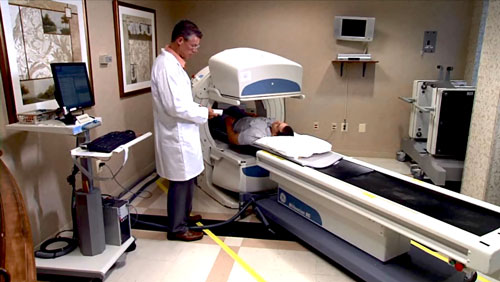
The gamma camera detects the energy from the radiotracer in your body and converts it into an image. The gamma camera itself does not emit any radiation. It has radiation detectors called gamma camera heads. These are often shaped like a box and attached to a round, donut-shaped gantry. The patient lies on an exam table that slides in between two gamma camera heads that are above and below the patient. Sometimes, the doctor will place the gamma camera heads at a 90-degree angle over the patient's body.
SPECT
In SPECT, the gamma camera heads rotate around the patient's body to produce highly detailed, 3D images.
PET
A PET scanner is a large machine with a round, donut-shaped hole in the middle. It looks like a CT or MRI unit. Multiple rings inside the machine detect the energy from the radiotracer in your body. A computer converts that data into images.
Image Fusion
Many imaging centers combine nuclear medicine images with computed tomography (CT) or magnetic resonance imaging (MRI) to produce special views. Doctors call this image fusion or co-registration. Image fusion allows the doctor to see information from two different exams in one image. This leads to more precise information and a more exact diagnosis. Single photon emission CT/CT (SPECT/CT) and positron emission tomography/CT (PET/CT) units can perform both CT imaging and nuclear medicine exams at the same time. PET/MRI is an emerging imaging technology and is only available in some locations.
How does the procedure work?
Imaging
Nuclear medicine introduces a radiotracer into the body. Radiotracers accumulate in a specific organ or attach to certain cells in the body.
Your doctor typically injects the radiotracer into your bloodstream. You may also swallow or inhale it as a gas. The radiotracer accumulates in the area under examination, where it gives off energy. Imaging devices, such as a gamma camera, SPECT, and PET, detect this energy and, with the help of a computer, create pictures. These images show how your organs and tissues are functioning at a cellular level.
Nuclear medicine focuses on processes within the body, such as metabolism. Radiotracers concentrate in specific areas of the body called “hot spots.” Hot spots form where there is a lot of chemical or metabolic activity. “Cold spots” indicate a smaller concentration of radiotracer and less activity.
Therapy
A small amount of radioactive material is attached to a cell-targeting molecule. This compound is called a radiopharmaceutical. You will swallow or have an injection of the radiopharmaceutical. The radiopharmaceutical travels to the cells or area targeted for treatment. The targeted cells receive a high dose of radiation, which destroys them.
How is the procedure performed?
Imaging
Nuclear medicine tests are done on an outpatient basis. You may also have a test while you are hospitalized.
You will lie on an exam table. A nurse or technologist will insert an intravenous (IV) catheter into a vein in your hand or arm.
You will receive an injection of the radiotracer. Or you may swallow it or inhale it as a gas.
The radiotracer will travel through your body and build up in the area of your body being studied. This may take anywhere from several seconds to several days. Your doctor will tell you when imaging will begin and how long the procedure will last.
When imaging begins, the camera or scanner will take a series of images. The camera may rotate around you or stay in one position. You may need to change positions during the test. You will need to remain still for brief periods. In some cases, the camera may move very close to your body. This is necessary to get the best quality images. Tell the technologist if you have a fear of closed spaces.
You may have tests to measure radioactivity levels in your blood, urine, or breath. A technologist may pass a small hand-held probe over the body.
The length of time for nuclear medicine test varies. The actual imaging time ranges from 20 minutes to several hours. Your test may be done over a period of several days.
Young children may require gentle wrapping or sedation to help them hold still. If the exam uses sedation, you will be told if can feed your child on the day of the exam. A doctor or nurse who specializes in pediatric anesthesia will ensure your child's safety while under sedation. When scheduling the exam for a young child, ask if a child life specialist is available. A child life specialist is trained to make your child comfortable and less anxious without sedation. This specialist will also help your child to remain still during the examination.
After the exam, you may need to wait to make sure no more images are needed.
If you have an intravenous (IV) line for the procedure, your technologist will remove it. If you have another procedure scheduled for the same day, your IV will be left it in place.
Therapy
Radioactive iodine (I-131) therapy for hypothyroidism
The radioiodine I-131 is swallowed in a single capsule or liquid dose and is quickly absorbed into the bloodstream in the gastrointestinal (GI) tract. It concentrates in the thyroid gland, where it begins destroying the gland's cells. Radioactivity in the thyroid will gradually diminish over the next few days. You will get the maximum benefit from this treatment three to six months after treatment. Usually, a single dose is successful in treating hyperthyroidism. A second and third treatment may be needed but this is rare.
Radioactive iodine (I-131) therapy for thyroid cancer
Most thyroid cancers are treated by surgically removing the thyroid gland. Radioactive iodine therapy is often used after surgery to destroy any remaining thyroid, including healthy tissue and cancer cells. You will swallow a capsule or pill that contains radioactive iodine (I-131). Both healthy and cancerous thyroid cells absorb the I-131, which destroys them. This treatment usually takes place in a hospital. You may stay overnight. During the treatment and for a short period afterward, you will give off radiation. Your doctor will tell you how to protect your family, friends, and pets at home.
Radioimmunotherapy (RIT)/Yttrium-90 Tiuxetan (Zevalin ®)
RIT is usually performed on an outpatient basis. It involves several trips to the treatment facility.
On the first visit, you will receive a dose of the monoclonal antibody (without radioactive material) through an intravenous (IV) injection. The monoclonal antibody will attach to non-cancerous B cells in your body to protect them from radiation. This IV infusion may take up to five hours.
You will return to the hospital during the following week to have another IV injection of non-radioactive monoclonal antibody. When that is complete, you will have the radioactive monoclonal antibody injected. This injection will take an hour.
I-131 MIBG Therapy
You will receive I-131 MIBG therapy through a small tube (cannula) inserted into a blood vessel on the back of your hand. The therapy involves an IV infusion, which may last between 90 minutes and four hours. You will stay in the hospital five to seven days while the radiation leaves your body, mostly through urine. Special arrangements are made for parents of young patients to allow them to help the care for their child while undergoing this therapy.
Lu-177 dotatate Therapy (Lutathera®)
A peptide that binds to the surface of GET-NETs is combined or “radiolabeled” with the radionuclide Lu-177. You will receive this radiopharmaceutical as an intravenous (IV) infusion. You will most likely have four treatments scheduled 8 weeks apart. Treatment sessions last most of the day. During treatment, you will have a nuclear medicine scan to check the location of the Lu-177 in your body.
Radionuclide Therapies for Bone
- Radium-223 dichloride (Xofigo®)
- Strontium-89 chloride (Metastron®)
- Samarium-153 (Quadramet®)
You will receive these therapies as an intravenous (IV) infusion. A typical course of therapy includes several treatment sessions separated by a period of weeks.
What will I experience during and after the procedure?
Imaging
Except for intravenous injections, most nuclear medicine procedures are painless. Significant discomfort and side effects are rare.
You will feel a slight pin prick when the technologist inserts the needle into your vein for the intravenous line. You may feel a cold sensation moving up your arm during the radiotracer injection. Generally, there are no other side effects.
Radiotracers have little or no taste. Inhaling a radiotracer feels no different than breathing the air around you.
With some procedures, the technologist may place a catheter into your bladder. This may cause temporary discomfort.
It is important to remain still during the exam. Nuclear imaging causes no pain. However, having to remain still or in one position for long periods may cause discomfort.
Unless your doctor tells you otherwise, you may resume your normal activities after your exam.
A technologist, nurse, or doctor will provide you with any necessary special instructions before you leave.
The small amount of radiotracer in your body will lose its radioactivity over time through the natural process of radioactive decay. Much of it will pass out of your body through your urine or stool the first few hours and days after your test. Drink plenty of water to help flush the radiotracer out of your body. You will need to follow safety precautions to keep from exposing other people to radiation. See the Radiation Safety page for more information.
Your doctor will tell you how often and when you will need to return for further procedures.
Therapy
Except for intravenous injections, most nuclear medicine procedures are painless. Significant discomfort and side effects are rare.
You will feel a slight pin prick when the technologist inserts the needle into your vein for the intravenous line.
Following radionuclide therapies and I-131 radioiodine treatment, the technologist or nurse will give you special safety precautions to follow once you return home.
Radionuclide therapies may cause side effects including:
- Lu-177: vomiting, nausea, decreased blood cell counts, increased liver enzymes, decreased blood potassium levels and increased glucose in the bloodstream
- MIBG: high blood pressure, feeling sick, and a drop in the level of platelets in your body
- Yttrium-90: nausea, stomach pain, diarrhea, fever, cough, stuffy nose, sore throat, sinus pain, weakness, tiredness
- Radium 223: diarrhea and sickness, low levels of blood cells
- Strontium-89: black, tarry stools, blood in urine or stools, cough or hoarseness, fever or chills, lower back or side pain, painful or difficult urination, pinpoint red spots on skin, unusual bleeding, or bruising.
- Samarium-153: decreased function of bone marrow, decreased blood platelets, low levels of white blood cells, nausea, and vomiting.
Who interprets the results and how do I get them?
A radiologist or a nuclear medicine specialist will interpret the images and send a report to your referring physician.
What are the benefits vs. risks?
Benefits
- Nuclear medicine exams provide unique information that is often unattainable using other imaging procedures. This information may include details on the function and anatomy of body structures.
- Nuclear medicine provides the most useful diagnostic or treatment information for many diseases.
- A nuclear medicine scan is less expensive and may yield more precise information than exploratory surgery.
- Nuclear medicine offers the potential to identify disease in its earliest stage, often before other diagnostic tests can detect symptoms or abnormalities.
- By detecting whether lesions are likely benign or malignant, PET scans may eliminate the need for surgical biopsy or identify the best biopsy location.
- PET scans may provide information for radiation therapy planning.
- Radionuclide therapies target cancer cells while limiting the radiation exposure to healthy tissue. They are typically well-tolerated.
- Treatment periods may be shorter than other cancer treatments with fewer side effects.
Risks
- Nuclear medicine exams use only a small dose of radiotracer acceptable for diagnostic exams. The potential benefits of an exam outweigh the very low radiation risk.
- Doctors have been using nuclear medicine diagnostic procedures for more than six decades. There are no known long-term adverse effects from such low-dose exposure.
- Your doctor always weighs the benefits of nuclear medicine treatment against any risks. Your doctor will discuss the significant risks prior to treatment and give you an opportunity to ask questions.
- Allergic reactions to radiotracers are extremely rare and usually mild. Always tell the nuclear medicine personnel about any allergies you may have. Describe any problems you may have had during previous nuclear medicine exams.
- The radiotracer injection may cause slight pain and redness. This should rapidly resolve.
- Women should always tell their doctor and radiology technologist if there is any possibility that they are pregnant, or they are breastfeeding. See the Radiation Safety page for more information about pregnancy, breastfeeding and nuclear medicine exams.
- Radiation detection security devices may be sensitive to the radiation levels present in patients who have recently had radionuclide therapies.
What are the limitations of General Nuclear Medicine?
Nuclear medicine procedures can be time consuming. It can take several hours to days for the radiotracer to accumulate in the area of interest. Plus, imaging may take up to several hours to perform. In some cases, newer equipment can substantially shorten the procedure time.
The resolution of nuclear medicine images may not be as high as that of CT or MRI.